Makar Sankranti
Makar Sankranthi, or Sankranti is a popular Indian festival. It is celebrated in many parts of the country and in some other parts of the world with great zeal and enthusiasm. It is a harvest festival, which is celebrated in the Hindu communities. The festival marks the day when the sun begins its northward journey and enters the sign of Makar (the Capricorn) from the Tropic of Cancer. It is like the movement of sun from Dakshinayana (south) to Uttarayana (north) hemisphere. It is the one of the few chosen Indian Hindu festivals which has a fixed date. This day falls on the 14th of January every year according to the Hindu Solar Calendar. The festival is considered to be a day from where onwards all the auspicious ritualistic ceremonies can be solemnized in any Hindu family. This is thus considered as the holy phase of transition.
Makar Sankranti holds special significance as on this day the solar calendar measures the day and night to be of equal durations on this day. From this day onwards, the days become longer and warmer. It is the day when people of northern hemisphere, the northward path of the sun marks the period when the sun is getting closer to them. The importance of the day was signified by the Aryans who started celebrating this day as an auspicious day for festivities. The reason behind this may be the fact that it marked the onset of harvest season. Even in the epic of Mahabharata, an episode mentions how people in that era also considered the day as auspicious. Bhishma Pitamah even after being wounded in the Mahabharata war lingered on till Uttarayan set in, so that he can attain heavenly abode in auspiciuous times. It is said that death on this day to brings Moksha or salvation to the deceased.
Makar Sankranti is celebrated in almost all parts of India in myriad cultural forms, with great devotion. Millions of people take a dip in places like Ganga Sagar (the point where the river Ganges meets the Bay of Bengal) and Prayag and pray to the Sun God (Surya). In the western Indian state of Gujarat, the celebrations are even bigger. People offer thousands of their colorful oblations to the Sun in the form of beautiful kites. The act stands as a metaphor for reaching to their beloved God, the one who represents the best. Makara Sankranti is also to honour, worship and to pay respect to Saraswati (Goddess of Knowledge). At the start of this significant event, there is also worship for the departed ancestors.
Makara Sankranti identifies a period of enlightenment, peace, prosperity and happiness followed by a period of darkness, ignorance and viciousness with immense sorrow. The six months of northern movement of the sun is followed by six months of southern movement. Since the festival is celebrated in mid winter, food prepared for this festival is such that it keeps the body warm and gives high energy. Ladduof til made with Jaggery is a specialty of the festival. In the western Indian state of Maharashtra, it is called 'Tilgul'. In Karnataka, it is called 'Yellu-Bella'. In some states, cattle are decorated with various colours and are made to jump over a bon-fire. It is celebrated differently in different regions of India.................................

Showing posts with label FESTIVALS OF INDIA. Show all posts
Showing posts with label FESTIVALS OF INDIA. Show all posts
Friday, January 14, 2011


Friday, August 20, 2010
Hi friends,
Happy vara lakshmi vratham...............to all of you.

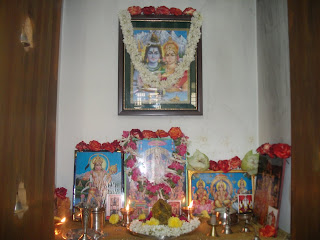
Happy vara lakshmi vratham...............to all of you.

The Hindu festival going by the name 'Vara Lakshmi Vratha' is celebrated on the Friday before the full moon in the Tamil Month 'Aadi' which corresponds to the English months of July-August. It is a festival to propitiate the goddess Lakshmi, the consort of Vishnu, one of the Hindu Trinity. Varalakshmi is one who grants boons (Varam).
It is said that Lakshmi will enter the house of anyone who thinks of her and bless them. There are many festivals in the year dedicated to Goddess Lakshmi. Among them, Varalakshmi Vratham is considered very auspicious because it is marked by strict observance of certain practices and austerities. It is also called Varalakshmi Nonbu.
The name Vishnu really means pervading everywhere, and Lakshmi, his consort, is symbolical of the forces found everywhere. Eight forces or energies are recognised and they are known as Sri (Wealth), Bhu (Earth), Sarasvati (Learning), Priti (Love), Kirti (Fame), Santi (Peace), Tushti (Pleasure) and Pushti (Strength). Each one of these forces is called a Lakshmi and all the eight forces are called the Ashta Lakshmis or the eight Lakshmis of the Hindus. As health, wealth and prosperity depend upon the rythmic play of these forces, the worship of Lakshmi is said to be to obtain these three. Hence this festival is observed, invoking the blessings of Lakshmi.
The pooja room is cleaned the previous day (Thursday) and floral decorations and kolam with rice flour should be done. After cleaning the sombu (kalasam), put some coins, betel, betel nut, turmeric, lemon, comb, mirror, black bangles (very small), black beads, raw rice, kunguma chimizh (very small one) inside it. Arrange the mango leaves over this and keep a coconut on top. Fix the amman face on the coconut, then decorate the kalasam with flowers. Place some flowers. Keep the sombu in the pooja, prepare ven pongal for neivedhyam. Have faith that Goddess Lakshmi Herself is residing in that Kalssam. Perform karpoora aarathi.
This pooja must be done with utmost dedication.To start the pooja, keep the goddess near the entrance of the house on the kolam (inside the house). Keep flowers. Then take karpoora aarathi. Then bring the deity to the pooja place singing the song "Lakshmi Raave maa inti ki" which means "Lakshmi please come to our house". In the mandha haasam, place a plaintain leaf and spread raw rice. Keep the kalasam on this and decorate the deity. Keep the nombu saradu (yellow thread) also.
First perform Vinayaka pooja to vinayaka (a conical shape made of turmeric powder). After finishing that pooja, start varalakshmi pooja. There are specific slokas and mantras. You could run the pooja slokas from the cassette or recite. After the pooja, neivedhyam to be kept and do karpoora aarathi. After aarathi, the ladies must tie the nonbu saradu in their right hand, reciting the sloka requesting the Goddess to reside with self. Offer thamboolam to the ladies. Being a Friday, giving thamboolam for as many ladies as possible is auspicious. In the night, perform mangala aarathi.
Next morning, place some fresh flowers, offer neivedhyam and perform aarathi. Move the kalasam toward noth. This pooja is generally carried forward by daughters-in-law. However, the Goddess will be immensely pleased by this pooja done by anyone, be it cutomery or non-customery.
Legend or Story of Vara Laxmi Vratram is explained here. Vara Laxmi Vrata is observed on the Friday which comes before Shravan Purnima during Shravan month. Charumathi, a Brahmin woman lived in a town, Kundina. She was very humble and kind in her nature. She was very much devoted to her husband and family.
One night, Goddess Laxmi appeared in her dream and told her to worship Vara Laxmi and seek her blessings. Goddess Laxmi also explained the Vrata procedure and the best day to observe Vara Laxmi Vrata. Laxmi asked Charumathi to observe Varalaxmi Vrata on the Friday just before Shravan Purnima, the Full Moon day in Shravan Month.
Charumathi informed about the dream to his husband and family. She also told to her friends and the word spread throughout the town. On the Friday before Shravan Purnima, Charumathi along with her family, friends and the women of the town observe Vara Laxmi Vrata. They worshipped Vara Laxmi with utmost devotion and offered special recipes and fruits to please her.
Goddess Vara Laxmi appeared before them and granted boons to all of them. Their houses were filled with grains, diamonds, jewels and gold. They all lived happily in their rest of life. Since the time, women have begun observing Vara Laxmi Vrata every year on the specific Friday

Subscribe to:
Posts (Atom)